
Views: 0 Author: Site Editor Publish Time: 2026-07-08 Origin: Site


Mooring system failures often unfold as high-risk, catastrophic events. Your entire mooring system remains only as reliable as its weakest connection point. This weak point is almost always the mooring shackle. Selecting this critical component goes far beyond simply buying accessible hardware. It demands a rigorous engineering decision. You must carefully balance Working Load Limit (WLL) capabilities. You also need to evaluate environmental corrosion resistance thoroughly. Assessing specific load angles is equally critical. If you ignore these factors, you risk sudden breakages under dynamic stress. Heavy weather conditions punish inadequate hardware mercilessly. This guide provides a comprehensive technical framework. We will help you evaluate, specify, and procure the correct hardware. You will learn exactly how to match specific hardware types to your operational demands. This applies to both permanent and temporary mooring setups. We focus strictly on maximizing maritime safety and operational longevity.
Load Direction Dictates Shape: Use bow (anchor) shackles for multi-directional loads and D-type (chain) shackles strictly for straight-line tension.
Pin Security is Critical: Bolt-type pins with cotter keys are mandatory for long-term or permanent mooring to prevent accidental backing out under dynamic loads.
Specialized Connections Matter: For seamless chain-to-chain connections that must pass over a windlass, specify a Kenter shackle or specialized joining shackle.
Match WLL, Not Just Size: The WLL of the mooring shackle must meet or exceed the Minimum Breaking Load (MBL) requirements of the attached mooring chain, factoring in a safe design margin.
Premature wear or sudden catastrophic failure frequently results from miscalculating dynamic forces. Wind, waves, and tides exert immense, continuous pressure on your marine infrastructure. Environmental degradation also accelerates hardware failure rapidly. Galvanic corrosion easily weakens structural integrity over time. We must frame this as a critical engineering challenge. It is never a simple procurement task.
When you evaluate your options, consider these core dimensions carefully:
Working Load Limit (WLL) vs. Minimum Breaking Load (MBL): You must establish a strict safety factor. Marine classification standards provide essential guidelines. Institutions like ABS (American Bureau of Shipping) or DNV set authoritative baselines. You should ensure the WLL adequately covers your maximum operational stress. MBL represents the point of absolute physical destruction. WLL represents your safe daily working limit.
Direction of Pull: Assess whether your connection experiences strictly linear tension. Will it face lateral forces? Will it handle multi-point directional pulls? This specific assessment dictates the physical shape you ultimately require.
Environmental Exposure: Continuous submersion in high-salinity marine environments demands robust treatments. High salinity accelerates metal degradation rapidly. Plain untreated steel will fail extremely fast. You must mandate superior anti-corrosion applications to ensure long-term survivability.
One major risk consideration involves sudden storm conditions. Failing to account for massive shock loads will instantly push forces past standard WLL parameters. Dynamic shock loads multiply the effective weight of your vessel drastically. A calm sea load differs profoundly from a severe hurricane load. Always build a substantial safety buffer into your mathematical calculations. Your maritime hardware must survive worst-case environmental scenarios.
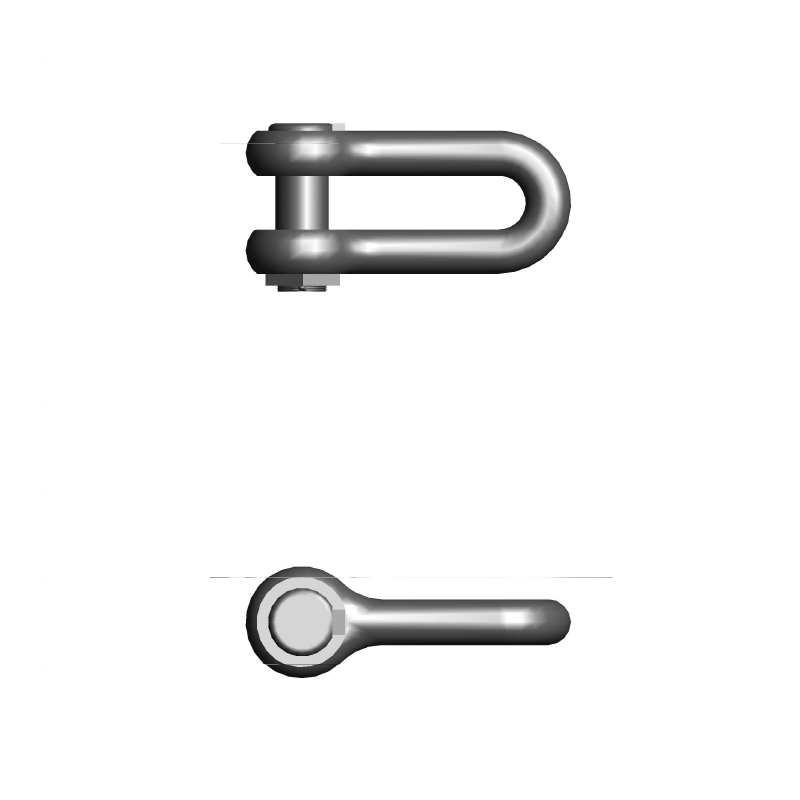
You must differentiate the two primary body styles based on expected load behavior. We categorize these solutions carefully. This prevents dangerous mismatched applications in the field. Using the wrong shape invites sheer stress and severe structural deformation.
These perform best for strictly in-line, straight-tension connections. Engineers design them specifically for linear pull scenarios. Connecting a chain directly to a single-point ring works perfectly here. The narrow D-shape keeps the load centered properly along the pin axis.
However, they carry a severe limitation. D-profiles are highly susceptible to dangerous twisting forces. They face critical failure risks if subjected to lateral side loads. Side loading bends the pin unnaturally. This compromises the entire structural integrity almost instantly. Never use them for multi-directional pulls.
These handle multi-directional loading exceptionally well. You use them primarily when connecting multiple legs simultaneously. A typical setup includes a heavy mooring chain, a swivel, and a primary anchor ring. You can rely on the spacious O-shaped bow. This enlarged loop accommodates several connection points easily without binding.
The implementation reality requires careful mathematical adjustments. Side-loading inherently reduces the overall WLL. Engineers call this process derating. Your selection logic must account for this lost strength. You can face up to a 50% capacity reduction at extreme pull angles.
Below is a standard derating reference chart for bow profiles:
Load Angle (Degrees) | Working Load Limit Reduction | Safe Operational Capacity |
|---|---|---|
0° (In-Line Pull) | 0% | 100% of Original WLL |
45° (Moderate Side Load) | 30% | 70% of Original WLL |
90° (Maximum Side Load) | 50% | 50% of Original WLL |
Always consult your manufacturer's specific guidelines. Derating percentages can fluctuate slightly based on proprietary metallurgical compositions.
Choosing the correct pin configuration involves very clear evaluation criteria. You must weigh the frequency of disconnection against severe environmental risks. Vibration-induced loosening is a constant threat in marine environments. Wave action creates relentless micro-movements underwater.
We recommend these primarily for temporary setups. They excel in situations requiring frequent deployments. They also work well for applications where visual inspection happens daily. The threaded pin allows quick, tool-free assembly in favorable surface conditions.
However, you must recognize the inherent operational risk. They remain highly prone to unscrewing dynamically. Chain torque and continuous wave vibration will loosen the threads over time. You must mouse them securely to mitigate this danger. Use heavy-duty stainless steel wire to lock the pin eye directly to the body. Mousing is mandatory for any extended underwater use. You should always link a standard Shackle properly to avoid accidental unthreading under stress.
This specific design serves as the definitive industry standard. We mandate it for permanent, long-term offshore installations. The mechanical mechanism is highly redundant. It features a heavy load-bearing bolt, a securing hex nut, and a secondary cotter pin.
The decision logic here heavily favors absolute safety. This triple-locking method completely eliminates the risk of pins backing out dynamically. The cotter pin physically stops the nut from turning. The nut keeps the bolt firmly seated inside the housing. You might face minor inconveniences during initial installation. Dealing with wrenches underwater is tedious. Yet, maximum operational security easily offsets those extra minutes of wrench time. Your vessel remains secure during severe weather events.
Standard connectors often create a distinct operational problem aboard vessels. They remain bulky and physically unrefined. Their protruding pins and wide bows will easily jam machinery. They can severely damage a ship's expensive windlass during rapid retrieval. Wildcat mechanisms cannot process oversized hardware smoothly. The teeth need precise, matching chain profiles to grip correctly.
We approach this complex solution by utilizing specialized flush connectors.
This highly specialized detachable link solves the clearance problem perfectly. It consists of two identically interlocking halves. It also includes a center chock and a secure locking taper pin. Engineers design it meticulously. It matches the exact profile of standard stud-link chains perfectly. When you need a completely smooth transition over gear teeth, a Kenter Shackle is essentially mandatory. It maintains the continuous link spacing without introducing wide friction points.
This is a modified D-type connector. It features a completely flush pin design. You use a Joining Shackle specifically for connecting long chain shots together. Profile clearance remains critical here to prevent mechanical fouling inside the hawsepipe. It offers high tensile strength while maintaining a slim physical footprint.
Implementation considerations require strict attention to mechanical detail. Kenter hardware demands precise dimensional matching. You must pair the exact chain pitch and specific wire diameter. Mismatched sizes will stress the interlocking halves unevenly. Ensure proper, heavy lubrication during the initial assembly process. Applying a thick coat of white lead or heavy marine tallow is standard practice. This simple step prevents permanent metal-on-metal seizing. You will appreciate this foresight after years of deep saltwater submersion.
Sizing logic requires a slightly counterintuitive approach for marine applications. The pin diameter of standard hardware usually measures larger than the chain wire diameter. The eyes of the body also add considerable thickness to the overall profile.
A very common sizing heuristic involves choosing hardware one size larger. For example, you would use a 5/8-inch connector for a 1/2-inch chain. This strategy ensures the pin still physically fits through the chain link opening. Simultaneously, it maintains a vastly superior WLL margin. Never downgrade your connector size to save weight.
Choosing the right metallurgy prevents rapid degradation.
Hot-Dipped Galvanized Steel: This serves as the undisputed baseline standard for marine applications. The thick zinc coating offers excellent sacrificial galvanic protection. It also maintains exceptional high tensile strength under load. The galvanization process actively heals minor surface scratches over time.
316/316L Stainless Steel: This premium alloy delivers superb surface aesthetics and corrosion resistance. However, it generally provides a significantly lower WLL compared to high-carbon steel. It also faces higher susceptibility to dangerous localized pitting. Crevice corrosion thrives in stagnant, oxygen-depleted saltwater environments. Engineers rarely use stainless steel for heavy commercial mooring arrays.
You must rigidly verify physical manufacturer stamps before installation. Check the embossed WLL rating, the specific batch code, and the official CE mark directly on the metal body. Missing stamps often indicate counterfeit or inferior hardware.
We strongly advise requiring official mill test certificates. Do this for all heavy-duty commercial procurement orders. This documentation officially ensures metallurgical integrity. It verifies the exact chemical composition and heat treatment processes used. Trusting unverified hardware introduces unacceptable operational hazards into your maritime ecosystem.
Selecting a resilient mooring connection requires careful alignment of several engineering factors. You must align the body shape precisely to your expected load angle. You must secure your pin aggressively for the entire duration of your deployment. You also need to match the WLL and physical dimensions directly to your existing infrastructure.
For permanent moorings, prioritize triple-secured bolt-type anchor designs to prevent dynamic unscrewing.
For smooth mechanical retrieval over machinery, utilize certified Kenter profiles.
Never compromise on verifiable metallurgical certification from authoritative manufacturers.
Your next steps require deliberate action. Consult a reputable manufacturer's load chart carefully. Cross-reference your specific chain’s MBL against the rated capacities. Finally, request exact technical specifications from certified marine hardware suppliers. Doing so guarantees the long-term safety of your valuable maritime assets.
A: It is highly discouraged unless the pin is aggressively seized with heavy-duty stainless steel wire. Bolt-type shackles are the engineered standard for permanent submersion.
A: A joining shackle is specifically engineered to have a flush profile, allowing it to pass smoothly over a gypsy/windlass without jamming, whereas standard chain shackles have protruding pin heads.
A: Side-loading alters the geometry of the tension, placing sheer stress on the pin rather than evenly distributing it across the bow. Always consult the manufacturer's derating chart for angles greater than 0 degrees.
A: Not necessarily. Shackle strength is often rated differently than chain. You must match the WLL, which frequently means the shackle body/pin will be one size larger than the chain diameter, provided the pin still physically fits through the chain link.


