
Views: 0 Author: Site Editor Publish Time: 2026-07-21 Origin: Site


Marine engineers and vessel operators face critical choices when finalizing anchor chain configurations. Selecting the wrong connecting link directly compromises windlass gypsy integrity. It also risks dangerous chain jamming during high-stress marine deployments. Worse, mismatched connection hardware can instantly invalidate classification society compliance. We designed this article to prevent those severe operational failures. You will find an evidence-based comparison between specialized connection links and traditional D-type hardware. We aim to guide your final procurement decisions based strictly on mechanical fit, operational safety, and application constraints. Understanding these structural differences ensures smooth windlass transit and reliable anchoring in extreme offshore environments. Choosing correctly prevents sudden point-loading failures under massive tension. Let us dive into the precise engineering mechanics. We will determine exactly which hardware suits specific connection points within your overall mooring layout.
Profile Matching: Kenter shackles mimic the exact dimensions of standard stud link anchor chains, ensuring seamless passage over a windlass; standard joining shackles typically have a larger profile.
Application Placement: Kenter links are strictly designed for mid-line chain connections (joining shots of chain); D-type joining shackles are generally reserved for end connections (chain to anchor or swivel).
Installation Complexity: Kenter shackles require specific assembly tools (spile pins, lead plugs) and precise alignment; standard joining shackles offer a more straightforward, albeit bulkier, mechanical connection.
Compliance: Both types require strict adherence to U2/U3 chain grade standards and mandatory Class certification (e.g., DNV, ABS) prior to procurement.
Modern mooring systems rely on seamless interaction between the anchor chain and the windlass. The wildcat, often called the gypsy, serves as the primary bottleneck in this system. Engineers calibrate these heavy-duty winches to accommodate highly specific chain pitches. The gypsy whelps must cup each chain link perfectly. Any deviation in link geometry causes the chain to jump out of the pocket. This jumping creates severe uneven load distribution across the equipment. When mismatched hardware passes over the wildcat, it instantly threatens the structural integrity of the entire assembly.
Several distinct failure vectors emerge when you install the wrong link. First, you face premature wear on the gypsy whelps. The grinding action of oversized hardware strips away hardened steel surfaces. Second, point-loading failure becomes a severe risk under high tension. The chain tension focuses violently on a single mismatched point rather than distributing evenly. Finally, you risk critical deployment delays. A jammed link in harsh marine environments endangers the vessel and the crew. You simply cannot afford a stuck anchor during sudden squalls or heavy tidal shifts.
We must frame this procurement decision carefully. You are not simply choosing a preferred hardware style. You are executing a strict engineering requirement dictated by the connection location. Mid-line connections demand entirely different geometries than end-terminal connections. Vessel operators must analyze their entire chain layout before making a selection. Ensuring total compatibility protects the wildcat and guarantees smooth chain transit under maximum load conditions.
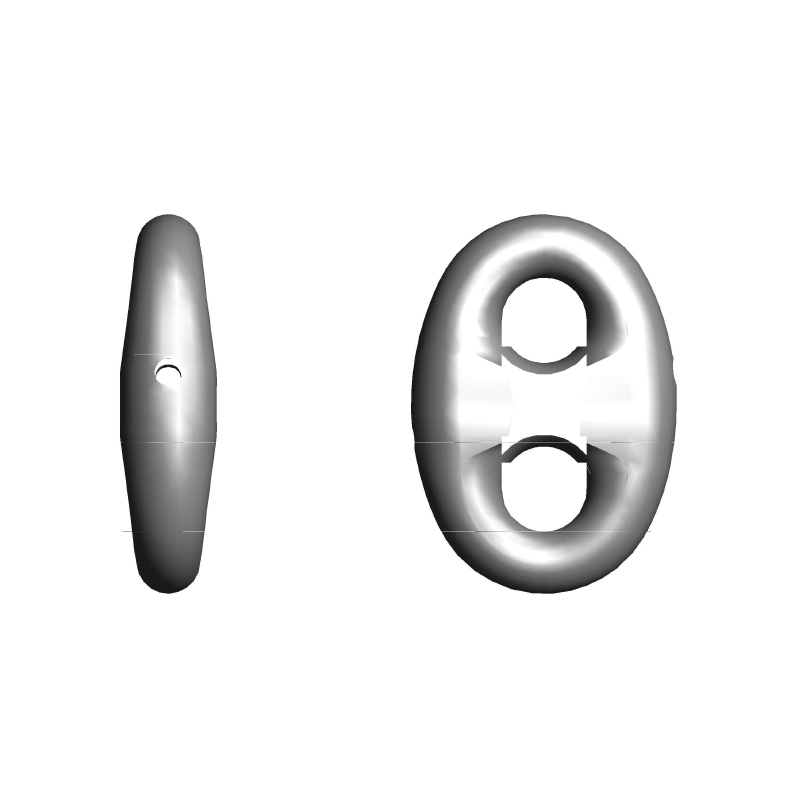
Engineers recognize the Kenter Shackle as a marvel of marine hardware design. It utilizes a highly specialized three-piece interlocking structure. The design features two symmetrical halves and a dedicated center stud. Once operators slide the halves together, they secure the assembly using a diagonal taper pin. They then lock this pin in place using a poured or hammered lead seal. This prevents the taper pin from backing out under heavy mechanical vibration.
The core advantage of this design is its identical footprint. It perfectly mimics common stud link chains. This seamless geometry allows the connection to travel horizontally or vertically through the windlass. It never snags on the gypsy whelps. The smooth profile maintains the exact pitch and outer dimensions of the surrounding chain shots. You can join multiple 15-fathom lengths together without introducing a bulky interruption.
However, this intricate design carries several implementation risks. You must follow strict assembly protocols to ensure safety.
Meticulous installation required: You must carefully align the halves. Locking the taper pin requires heating and pouring molten lead, or vigorously hammering lead pellets into the cavity.
Corrosion seizure risks: High-corrosion offshore environments easily fuse the internal interlocking faces. You must properly grease the mating surfaces (excluding the pin hole) during initial assembly.
Difficult field disassembly: Emergency separation requires specialized drift punches and heavy hammers. You cannot detach this link rapidly in challenging field conditions if the components have seized.
Understanding these limitations ensures you deploy the link correctly. Proper maintenance prevents the halves from galling together over years of saltwater exposure.
The standard Joining Shackle offers a robust, traditional approach to marine connections. This hardware focuses on a classic D-shape or bow-shape structural design. It relies on a heavy-duty, removable pin to secure the load. Engineers often secure this main pin using a stainless steel locking wire or a specialized cotter pin. The design prioritizes sheer ruggedness over seamless aerodynamic geometry. It relies on massive steel profiles to withstand brutal towing and anchoring forces.
The core advantage here lies in maintenance simplicity. Crews can perform visual inspections for wear much faster. They can easily spot severe pitting or pin deformation. Furthermore, detaching this hardware proves significantly easier compared to a heavily seized three-piece link. Removing a locking wire and knocking out a straight pin takes minimal effort. Maintenance crews heavily favor this design when rapid disconnection is necessary for frequent anchor swapping.
Despite these benefits, this bulky hardware presents critical implementation risks. You must never place it blindly into a system.
The D-shape profile is significantly wider and longer than a standard chain link. This oversized geometry introduces severe transit problems. It will absolutely not pass smoothly over a standard windlass gypsy. It requires specially designed pockets on the wildcat, which most standard winches lack. Consequently, operators must strictly limit its use to specific zones. You should only use it at the outboard end to join the anchor to the forerunner. Alternatively, you can use it safely at the inboard bitter end, where it never travels over the winch.
Comparing these two critical components reveals distinct operational boundaries. You cannot substitute one for the other without risking catastrophic mechanical failure. We must evaluate them across four primary engineering dimensions. This ensures you match the precise hardware to its intended zone.
Evaluation Criteria | Kenter Design | Standard D-Type Design |
|---|---|---|
Geometry & Transit | Matches standard link footprint. Provides seamless windlass transit without snagging. | Oversized D-profile. Causes severe windlass jamming. End-terminal use only. |
Tensile & Break Load | Meets identical Class proof and break loads corresponding to chain grade. | Meets identical Class proof and break loads corresponding to chain grade. |
Installation Tooling | Requires hammers, drift punches, lead wire/plugs, and specialized alignment. | Requires basic hand tools for pin locking and stainless wiring. |
Cost Efficiency | Prevents catastrophic windlass damage when used mid-chain. | Lower unit replacement cost, but misapplication destroys the gypsy. |
Notice that tensile strength remains equal. Both designs must meet identical proof and break loads corresponding to the specified chain grade (such as Grade 3 or Grade 2). Neither design is inherently stronger if you size it correctly. The true difference lies in their geometry and application.
When selecting your hardware, follow this standardized evaluation process:
Map the Connection Point: Determine if the connection sits mid-line between chain shots or at an end terminal.
Assess Windlass Interaction: Check if the link must pass over the gypsy under load. If yes, you must use the seamless profile.
Review Maintenance Tooling: Ensure your vessel crew possesses the exact drift punches and lead plugs required for emergency disassembly.
Verify Load Ratings: Confirm both the hardware and the adjacent chain share the exact same Minimum Breaking Load (MBL) rating.
Selecting the right hardware depends entirely on stringent manufacturing standards. You must partner with a highly credible marine shackle supplier to guarantee operational safety. Inferior metallurgy leads to invisible stress fractures and rapid galvanic corrosion. You must demand strict material verification protocols during your procurement phase.
Always demand independent metallurgical reports from your vendor. The high-tensile steel used in the hardware must perfectly match the exact grade of your existing anchor chain. Mixing mismatched steel grades accelerates galvanic corrosion in saltwater. It also creates a dangerous load mismatch under peak tension. The weaker component will inevitably yield first, snapping the mooring line.
Classification and certification form the backbone of maritime safety. A trusted vendor must provide recognized IACS member certificates. Look for documentation from Lloyd's Register, ABS, or DNV. Furthermore, you must verify full traceability. Ensure the factory stamps corresponding heat numbers directly onto the heavy hardware. This allows you to trace the steel back to its original casting batch.
Finally, mandate rigorous Non-Destructive Testing (NDT) before accepting delivery. Cast and forged steel often hide microscopic internal flaws. These voids and micro-cracks remain completely invisible to standard visual inspection. Ensure the supplier conducts Magnetic Particle Inspection (MPI) or Ultrasonic Testing (UT) on all connection halves. Catching these structural defects in the factory prevents catastrophic chain separation out on the open ocean.
Making the correct connection choice safeguards your entire mooring system and protects your expensive windlass machinery. Choose a Kenter design specifically for joining standard 15-fathom chain lengths together. Its seamless geometry ensures safe, continuous operation over the gypsy. Conversely, choose a standard D-type design strictly for connecting the chain to the anchor swivel assembly or securing the inboard bitter end.
Take immediate action to secure your vessel configurations. Instruct your engineering buyers to audit their current onboard chain grade (U2 or U3). They must accurately measure the exact nominal diameter of the existing links. Once verified, request comprehensive technical drawings and certified load test documents from your short-listed suppliers. Do not finalize any hardware procurement until you confirm full IACS class compliance.
A: Yes, provided the two halves and the center stud show no plastic deformation or severe pitting. You must inspect the mating surfaces carefully. However, you cannot reuse the sealing components. The taper pin and the lead plug must be replaced with brand-new ones every time you reassemble the unit to ensure a secure lock.
A: You must thoroughly clean and grease all mating surfaces before assembly. Never apply grease inside the taper pin hole. You must drive the taper pin home fully using appropriate force. Finally, you must hammer the lead plug in securely. This vital step prevents the pin from backing out under heavy mechanical vibration.
A: No. When manufactured to identical Class standards, neither component is inherently weaker. If you match them to the exact same chain diameter and grade, laboratories test both to the exact same Proof Load and Minimum Breaking Load (MBL). Their differences lie entirely in geometry and application placement.


